



Rethinking Insert Size: Engineering Productivity with Less Carbide
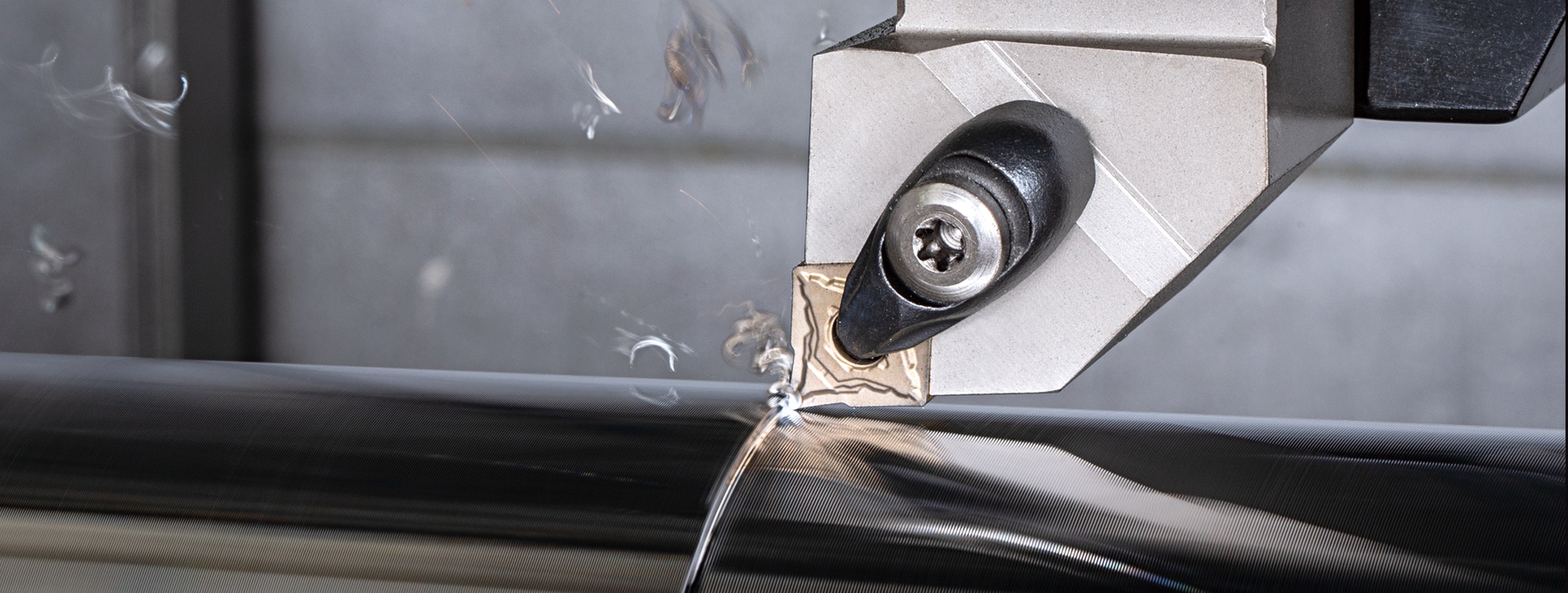
As carbide raw material prices continue to rise, manufacturers are under increasing pressure to control tooling costs without compromising machining performance.
In turning operations, productivity is often associated with cutting speed, coatings, or machine capability. Yet another factor is becoming increasingly important: how efficiently carbide is used within the insert itself.
This shift is driving a new approach in tool design, one that focuses not only on performance, but also on material efficiency.
A Different Approach to Turning Efficiency
Traditional ISO turning inserts have been designed with relatively large carbide volumes to ensure strength and durability. In practice, however, many turning operations do not require that volume to achieve stable results.
Tungaloy’s ISO-EcoTurn addresses this gap.
By reducing insert size while maintaining the functional cutting edge geometry, ISO-EcoTurn lowers carbide consumption per insert while preserving the capability required for common turning operations, including external turning, facing, profiling, and finishing to medium cutting.
This approach is not about reducing performance. It is about using material more efficiently.
Designed for Real Machining Conditions
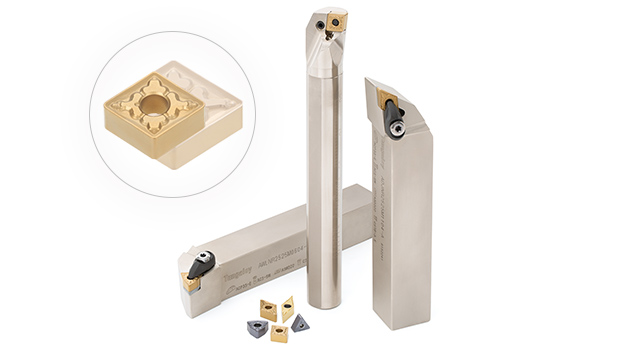
A common concern with smaller inserts is whether performance is compromised. With ISO-EcoTurn, performance is maintained through precise engineering.
The insert retains the same thickness as standard ISO inserts, ensuring comparable fracture resistance, including in interrupted cutting conditions. Optimized chipbreaker geometries support stable chip control across typical finishing to medium cutting applications.
More importantly, based on analysis of approximately 8,300 OD turning applications, 92.5% of operations are performed with a depth of cut of 3 mm or less. This means that most real-world machining falls within the effective cutting range of ISO-EcoTurn.
Smaller size does not limit capability. It aligns with actual machining requirements.
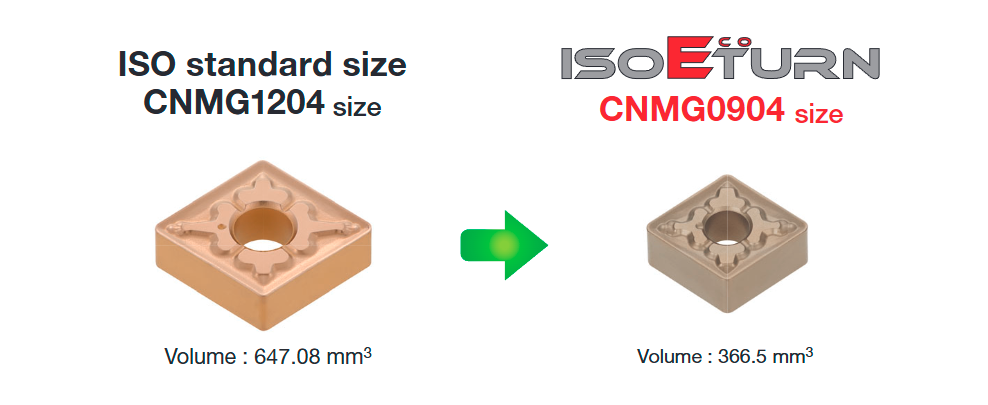
Insert volume reduced by 43%, leads to reduce raw material.
| Standard ISO Size | → | ECOTURN Size | Shape |
|---|---|---|---|
| CNMG1204 | → | CNMG0904E | Rhombus 80° |
| DNMG1504 | → | DNMG1104E | Rhombus 55° |
| TNMG1604 | → | TNMG1104E | Triangle 60° |
| VNMG1604 | → | VNMG1204E | Rhombus 35° |
| WNMG0804 | → | WNMG0604E | Trigon 80° |
* The trailing “E” is the ECOTURN identifier
Easy Adoption Without Process Changes
Efficiency improvements should not require complex changes on the shop floor.
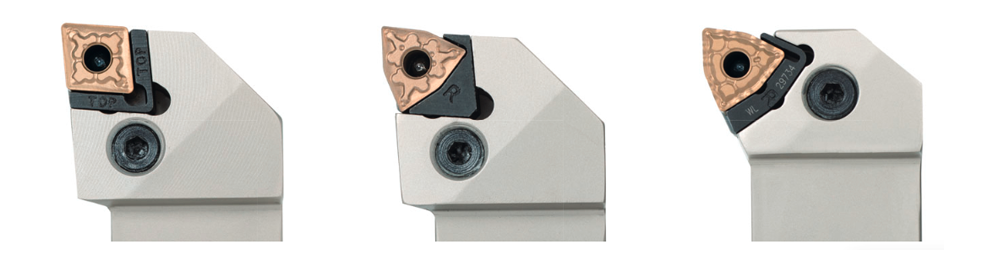
ISO-EcoTurn can be implemented using dedicated holders or conversion cartridges compatible with standard ISO toolholders. This allows manufacturers to adopt the system with minimal investment while maintaining existing setups and workflows.
Lineup Designed for Broad Coverage
ISO-EcoTurn is supported by a comprehensive lineup designed to cover a wide range of turning applications:
- Insert shapes (5): CNMG, DNMG, TNMG, VNMG, WNMG
- Chipbreakers (10):
- TF for precision finishing
- TSF, FW, ZF, SS for finishing
- SW for finishing to medium cutting, including wiper geometry
- TM, ZM, NM, SM for medium cutting
- Grades (11):
- CVD: T9205, T9215, T9225, T515, T6215, T6225
- PVD: AH6225, AH8015, AH120
- Cermet: NS9530, GT9530
This combination supports a broad range of materials and machining conditions:
- Steel (P) — T9205, T9215, T9225, NS9530
- Stainless Steel (M) — T6215, T6225, AH6225
- Cast Iron (K) — T515
- Non-Ferrous (N), Difficult-to-Cut (S), Hardened (H) — AH8015, AH120
This structured lineup ensures that ISO-EcoTurn can be applied across most standard turning environments, from finishing to medium cutting operations.
Productivity Is Engineered
ISO-EcoTurn demonstrates how insert design can evolve to meet modern manufacturing challenges.
By combining compact insert architecture with proven cutting performance, it enables manufacturers to reduce carbide consumption while maintaining stable and reliable machining operations.
In today’s environment, productivity is not only measured by cutting speed. It is also defined by how intelligently cutting tools are engineered.