



Keeping AI Cool: The Machining Behind Liquid Cooling Connectors
Artificial intelligence may live in the digital world, but supporting it is becoming an increasingly demanding physical engineering challenge.
As AI and High Performance Computing (HPC) infrastructure becomes more powerful, data centers are packing greater computing capability into increasingly dense server racks. More computing power also means more heat, accelerating the transition from conventional air cooling toward direct liquid cooling.
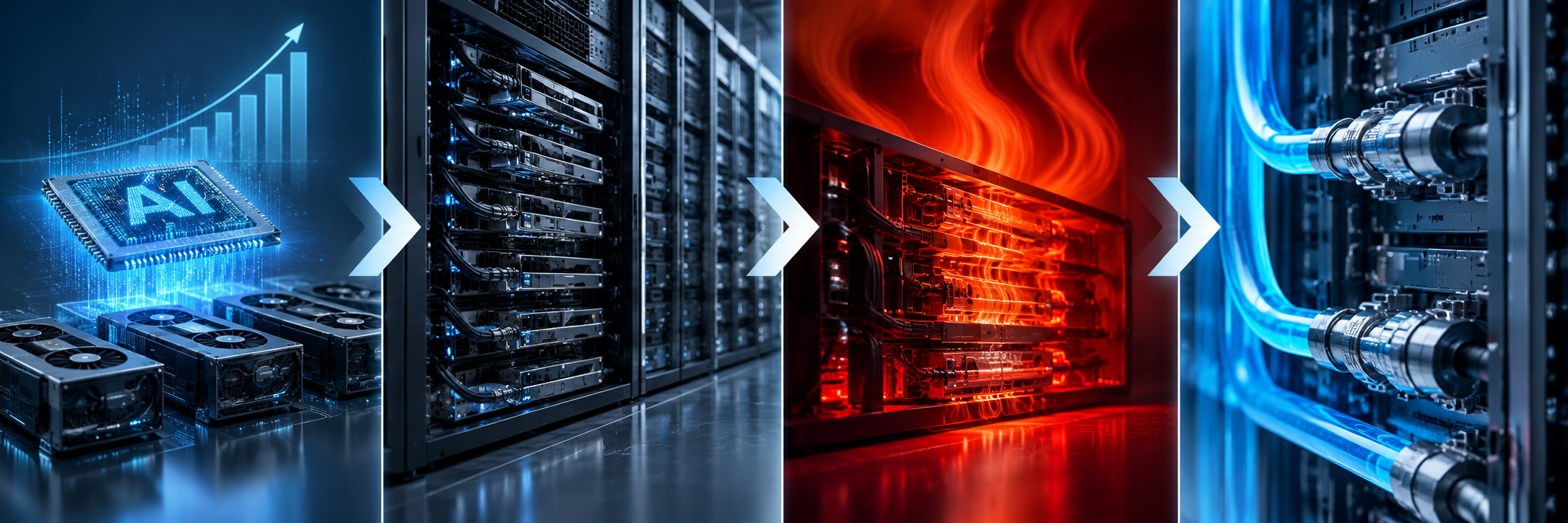
This transformation is creating growing demand for cold plates, manifolds, coolant distribution units and the precision connectors responsible for moving coolant safely through these systems.
For manufacturers, it is also creating a growing precision-machining application.
Small Components, Demanding Machining
Quick disconnect couplings allow different sections of a liquid cooling circuit to be connected and disconnected during server installation, replacement and maintenance. UQD, MQD and blind-mate designs serve different locations and space requirements within these increasingly compact cooling systems.
Although small, these components combine demanding functional requirements. Reliable sealing and coolant flow depend on accurate mating surfaces, internal geometries, grooves and other precision features.
They are commonly manufactured from corrosion-resistant stainless steels such as AISI 303, 304 and 316 — materials that can present challenges including heat generation, work hardening, built-up edge and difficult chip control.
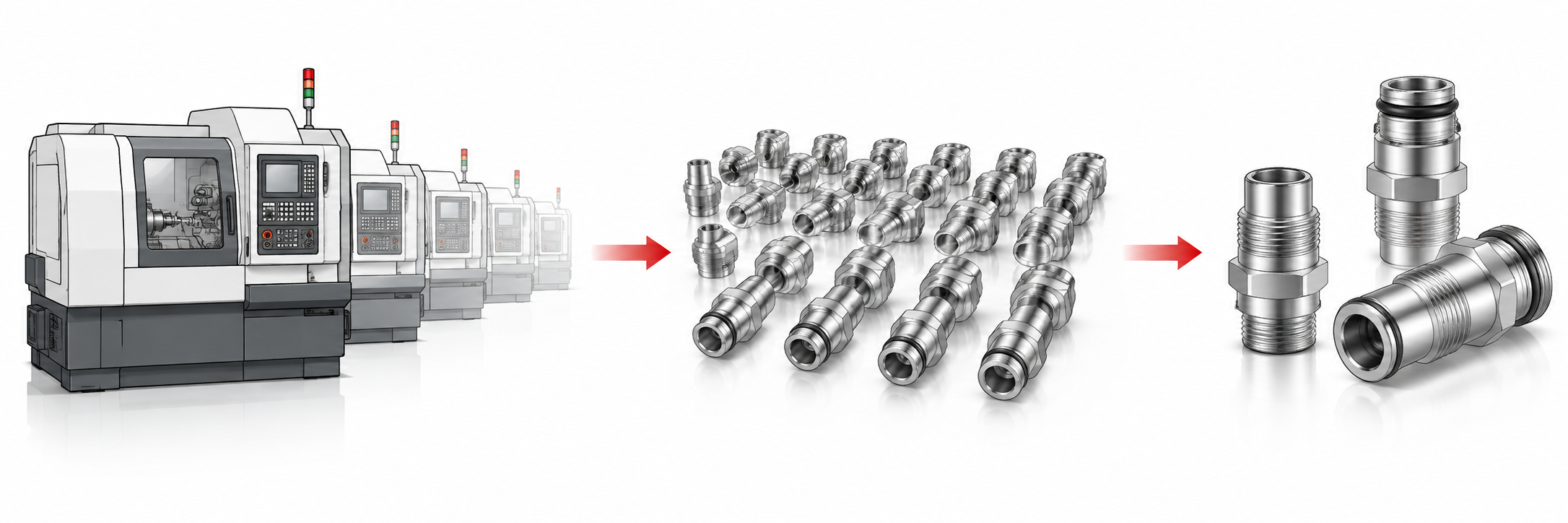
At the same time, a single connector may require turning, drilling, grooving, threading and milling. Maintaining dimensional accuracy, surface quality and chip control throughout these operations is essential, particularly in automated and Swiss-type production where uncontrolled chips can affect finished surfaces and process stability.
The challenge is therefore not simply machining a small stainless-steel component. It is producing these precision features consistently and efficiently at production scale.
Different Components, Different Machining Challenges
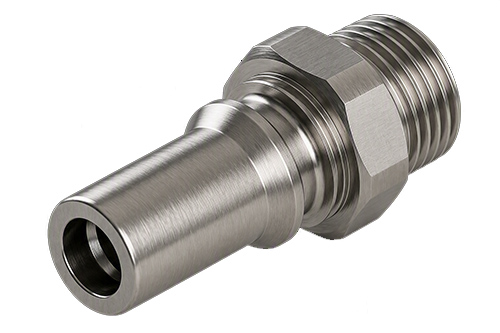
For the UQD plug body, cycle time is an important consideration in high-volume production. TFX (The Front Max) enables deeper depths of cut, reducing the number of passes required in external turning and helping shorten overall cycle time.
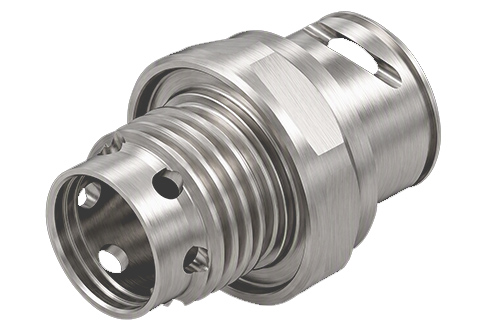
For the compact MQD socket body, the face groove at the connection interface is a critical machining feature. TetraMiniCut provides stable face grooving while its multi-corner insert design helps reduce tooling costs — an important consideration for volume production.
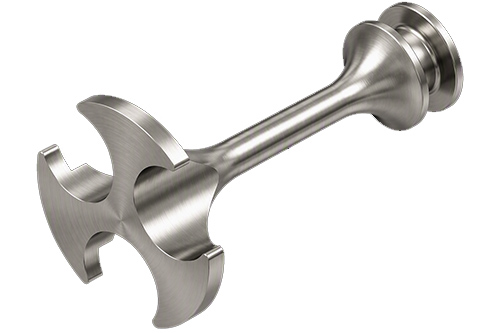
For the MQDB socket valve, the distinctive three-lobe profile creates a particular chip-control challenge, as chips can become trapped around the workpiece and interfere with stable machining. The TMV chipbreaker directs chips toward the chuck side, promoting reliable chip evacuation and helping prevent machining trouble.
The Machining Behind AI Infrastructure
Much of the discussion around AI infrastructure focuses on GPUs, computing performance, energy consumption and data-center capacity. But increasing computing density also creates new requirements for the physical infrastructure supporting it.
As direct liquid cooling expands across AI data centers and HPC systems, precision cooling connectors are becoming an increasingly relevant machining application.
Small in size but demanding in manufacture, these components require the right combination of tooling, stainless-steel machining knowledge and stable processes to achieve the accuracy and reliability expected from modern liquid cooling systems.
The infrastructure behind AI is therefore not only a computing and cooling story. It is also a machining story.