From Forging to Flight: Machining the High-Pressure Compressor Case
Aircraft delivery backlogs show how difficult it is for the aerospace supply chain to keep pace as airlines expand and renew their fleets. For engine manufacturers and their suppliers, that pressure reaches the shop floor. Each machining cycle has to make good use of machine time while holding the tolerances the finished component requires.

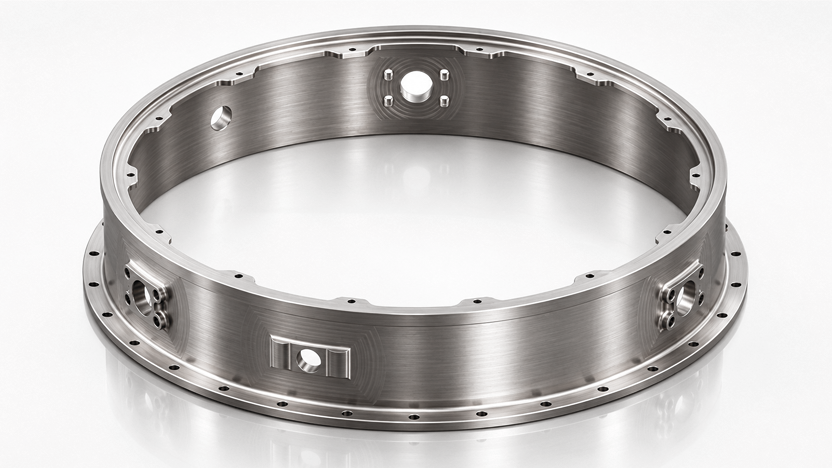
The high-pressure compressor (HPC) case shows why that balance is difficult. It starts as a rigid forging and takes shape as a thin-walled structure that supports the compressor section of the engine. Its bores must meet tight requirements for roundness and coaxiality. As material comes off, the walls can deflect more readily under cutting forces, just as the remaining cuts demand greater precision.
The first cuts set up the last
Inconel 718, the nickel-based superalloy in this example, retains its strength at elevated temperatures. During machining, it conducts heat poorly and tends to work-harden. The forging adds another challenge. Where the surface is uneven, the cutting edge can repeatedly enter and leave the cut.
In external rough turning, a round insert in Tungaloy’s AH8015 coated carbide grade provides a strong cutting edge as the depth of cut varies. In external grooving through the forged skin, NTK’s SX9 SiAlON ceramic grade is designed to resist chipping under repeated impact. For heavy rough turning where the operation can support higher cutting speeds, BIDEMICS JX3 offers a ceramic grade developed for toughness.
Milling the outer profile and the bosses
Rough milling the outer profile calls for efficient stock removal. NTK’s JRF Cutter uses double-sided SX3 ceramic inserts for high-speed roughing, with multiple usable edges per insert. Around the raised bosses, access can require greater tool overhang while the cut repeatedly engages and disengages. The CERAMATIC Brazed end mill combines an SX9 ceramic cutting section with a rigid carbide shank for this type of cut.
When the wall moves under the tool
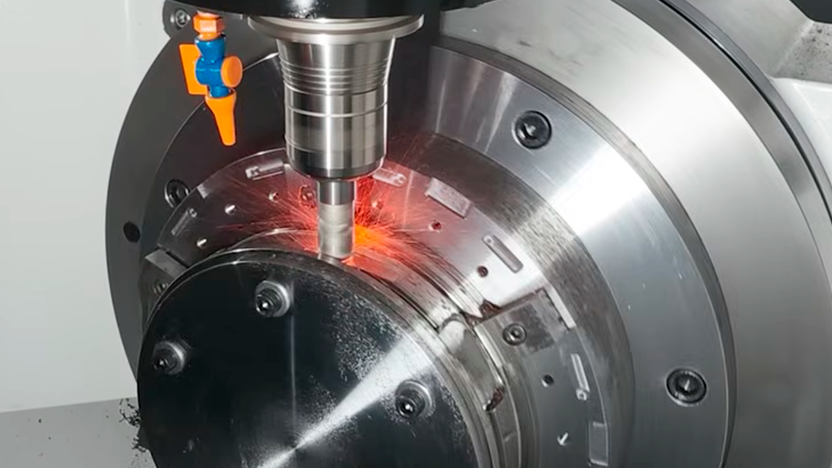
During a finish turning pass, cutting forces can push a thin wall away from the tool. When the load is removed, the wall springs back. The tool can follow the programmed path and still leave a surface out of tolerance. Research on finish turning thin Inconel 718 workpieces has also shown that tool wear can increase distortion. Edge condition matters to dimensional accuracy as well as surface finish.
A consistent finishing allowance helps keep the last pass predictable. In the application shown here, Tungaloy’s BX815 cBN grade is used for continuous external finish turning, where wear resistance helps maintain surface finish at higher cutting speeds.
By the time the case reaches final inspection, it carries the cost of every operation since the first cut. The value of faster roughing depends on what it leaves behind: a case that can be finished to tolerance, part after part.